Study
Comparing radius and driving areas for site analysis
A MarketGround study
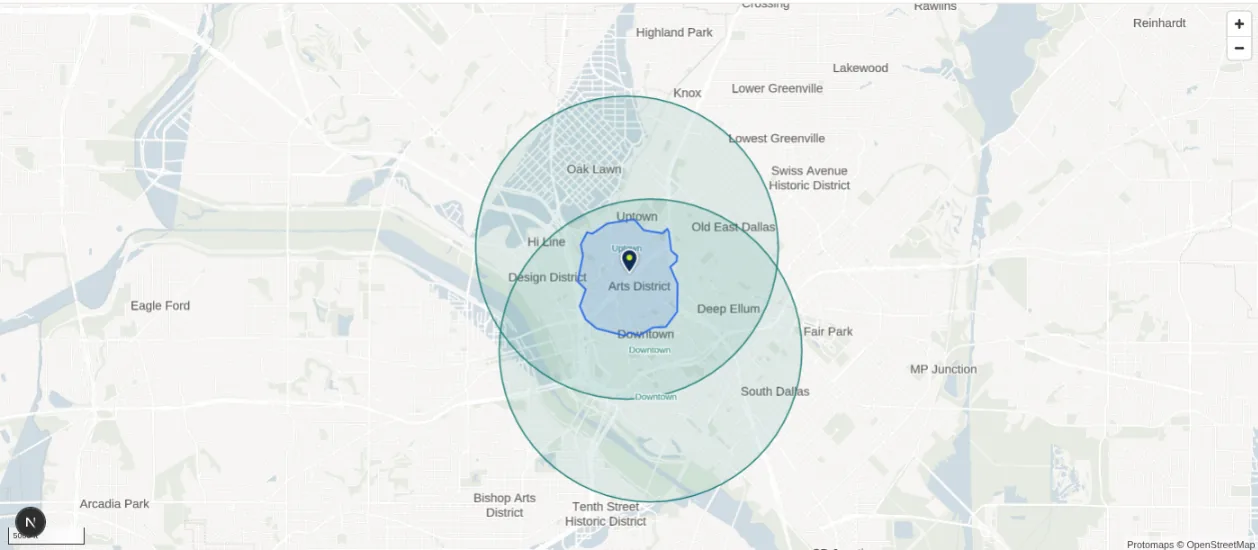
We analyzed four locations using a ten-minute driving area and a circle of approximately the same size. The comparison shows how the choice of boundary changes the population and income estimates around a site.
The method
Compare different shapes around the same point
For each location, we measured the ten-minute driving area and created a circle with approximately the same land coverage. This helps separate the effect of shape from the amount of area included. A standard three-mile circle provides an additional reference.
The result
Driving areas contain 4 to 36 percent more residents in these examples
| Site | 10-minute drive | Residents reached | Equal-area circle | Residents reached | Difference | Plain 3-mile circle |
|---|---|---|---|---|---|---|
| Tysons Corner, Virginia | 165.38 km² | 258,299 | 4.51 miles | 232,019 | +11% | 111,181 |
| Old Town Alexandria, Virginia | 67.53 km² | 163,886 | 2.88 miles | 129,344 | +27% | 141,147 |
| Rockwall, Texas | 110.11 km² | 81,321 | 3.68 miles | 59,709 | +36% | 42,006 |
| Legacy West, Plano, Texas | 215.61 km² | 355,711 | 5.14 miles | 343,533 | +4% | 99,809 |
Swipe the table sideways to see every column.
Driving areas use free-flow routing. Each equal-area circle is within half a percent of its corresponding driving area's size.
The case worth understanding
At Alexandria the circle is larger and contains fewer residents
A three-mile circle on Old Town Alexandria covers 73.07 square kilometers and contains 141,147 residents. The ten-minute driving area from the same point covers less ground, 67.53 square kilometers, and contains more people, 163,886. The circle spends a good part of itself on the Potomac and on ground that the road network does not serve within ten minutes, while the driving area runs up the dense corridors towards Arlington and Del Ray.
Median household income also differs, at $137,499 within the driving area and $129,338 within the three-mile circle. The two boundaries therefore describe different residential markets around the same location.
At Rockwall, the ten-minute driving area contains 81,321 residents, compared with 59,709 in the equal-area circle. The road network extends the driving area along the interstate, while the circle includes more lake and farmland. The standard three-mile circle contains 42,006 residents.
When the circle is fine
Legacy West has a smaller population difference
At Legacy West, the driving area contains 355,711 residents and the equal-area circle contains 343,533, a difference of about 4 percent. Median household income differs more, at $102,662 and $117,048 respectively. Comparing several measures helps explain how the boundaries describe different parts of the surrounding market.
What to do about it
Compare the boundaries and label your results
Use consistent rings to compare candidate sites, then examine travel areas based on how customers could reach them. Compare population and income across the boundaries. In your report, identify the shape and travel assumptions used for each result.
Methodology
How these numbers were made
Each ten-minute driving area starts at the coordinates below and uses free-flow routing. We measured its area and drew a circle of approximately the same size around the same point. Population and income were calculated for both shapes using the methods described on the methodology page.
One trap is worth naming because it is invisible. A travel-time area is computed from the nearest piece of road to the point you give it, so a point dropped on a field or a service track can produce a small, plausible and entirely wrong shape. The product reports how far the point had to move to reach the network and warns above 75 meters. All four points here snapped within a few meters.
| Site | Latitude, longitude | Driving area | Equal-area circle |
|---|---|---|---|
| Tysons Corner, Virginia | 38.9187, -77.2311 | 165.38 km² | 4.51 miles |
| Old Town Alexandria, Virginia | 38.8048, -77.0469 | 67.53 km² | 2.88 miles |
| Rockwall, Texas | 32.9312, -96.4597 | 110.11 km² | 3.68 miles |
| Legacy West, Plano, Texas | 33.0757, -96.8236 | 215.61 km² | 5.14 miles |
Swipe the table sideways to see every column.
Questions
Questions people ask
Is a three-mile radius ever the right trade area?
A three-mile radius is useful when you need a consistent distance comparison across locations. A driving area adds information about road access. The most useful choice depends on the question and the way customers travel.
How much difference does it make?
In this study, driving areas contained about 4 to 36 percent more residents than the corresponding equal-area circles. The largest difference was at Rockwall and the smallest at Legacy West.
Why does a circle sometimes reach fewer people over more ground?
Because area is not access. At Old Town Alexandria a three-mile circle covers 73.07 square kilometers and contains 141,147 residents, while a ten-minute driving area covers 67.53 square kilometers and contains 163,886. The circle spends a good part of its area on the Potomac and on ground the road network does not serve in ten minutes, while the driving area follows dense corridors.
Does drive time account for traffic?
The standard driving area is computed on the road network at free-flow speeds. Paid plans can also compute a driving area using typical traffic for a chosen day and hour, which matters at the locations where congestion is the whole story. The figures on this page use free-flow routing.
What about walking and public transit?
Both are available and both matter in the right place. A downtown lunch trade is a walking area, and in a metro area with real service a transit area reaches people no circle would include. The same allocation runs on whatever shape you produce.
Run it on your own site
Both boundaries, one afternoon
The guide on calculating the population within a ten-minute drive walks through the steps, and trade area analysis covers the rest of what arrives with the shape.
More analysis
Related research
Explore related studies and practical guides. Each article presents a geographic comparison and links to the methods behind it.
Compare daytime population, jobs and listed businesses within the same radius around four Northern Virginia employment centers.
Explore how household income varies within one Virginia ZIP area and compare two smaller site areas.
See how overlapping territories change the combined population estimate for two Plano locations.
Compare both boundaries around a familiar site
Draw a radius and a driving area from the same location. Review their size, population and income to see how the road network changes the area included.