Banking
The bank branches and credit union sites inside an area, branches per 10,000 residents against the nation, deposits per resident, how far residents live from a branch, the largest banks by local deposits and how concentrated the market is.
What this is for
Where the banks are says something about an area's money and its access to it. A neighborhood with many branches and large deposits is one where money is kept and lent. One whose residents live miles from the nearest branch is a banking desert, which bears on everything from check cashing to small business credit. The Banking card counts the branches inside an area, measures how far its residents are from one, and names the banks that hold the local deposits, beside the nation's figures where a comparison is meaningful. A bank reads it as the competition in a market it might enter, and a business reads it as a measure of how the area's residents are served.
These are counts and shares, not an index.
Where to find it
On the Economy tab, the card headed Banking, the last card before Indexes by location. Part of the Pro and Team plans.
How it is built
Bank branches are the full-service offices in the FDIC's Summary of Deposits inside the area, as of June of the year named. Credit union sites serving members are from the National Credit Union Administration's branch file. Branches per 10,000 residents counts both against the area's residents, beside the nation's figure.
Deposits at local bank branches per resident counts the deposits booked at the area's branches. Deposits are booked where an account sits, not where its owner lives, and a few head offices book deposits from across the country, with the 216 offices holding more than $5 billion each holding 46 percent of the nation's $19 trillion. Deposits per resident and each bank's share of the area's deposits therefore count only offices holding under $2 billion, so that a head office does not make a neighborhood read as the richest in America. Credit unions report deposits for the whole credit union, so they count as branches but not in deposits.
Residents more than 2 miles from a branch, more than 10 miles, and the median distance to the nearest branch are measured from the center of each small cell where residents live to the nearest bank branch or credit union site, weighted by the residents in each, for the area and for the nation. Credit union addresses are geocoded, and about one in ten that matches no address is placed at its ZIP code's center.
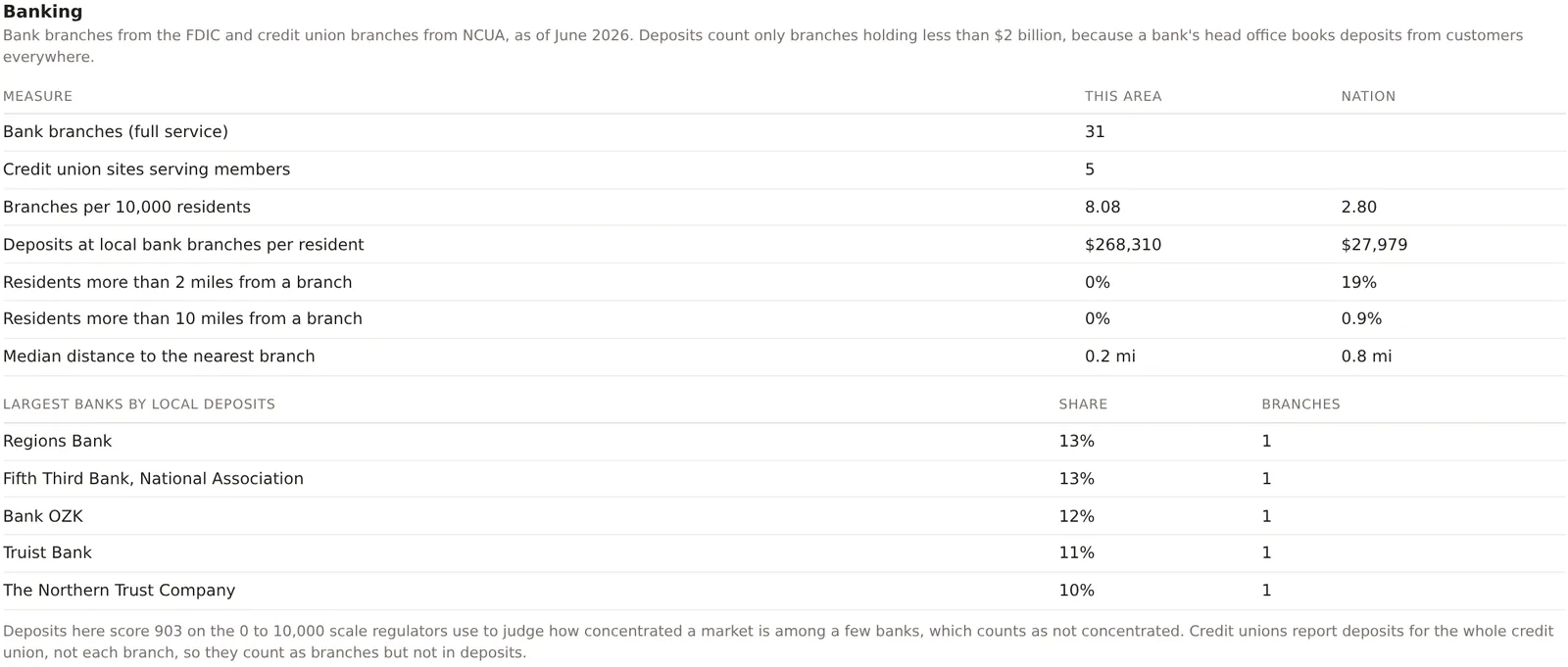
Largest banks by local deposits lists the five banks with the largest share of the area's deposits, with their branch counts, and the sentence beneath gives the Herfindahl index, the 0 to 10,000 scale regulators use to screen bank mergers, with the usual reading of it in words.
Reading the results
Branches per 10,000 residents beside the nation's figure says whether the area is well or poorly served. The distance lines say it for the residents rather than the branches, and the nation's 19 percent of residents more than 2 miles from a branch is the comparison for whether an area is a banking desert. Deposits per resident in a downtown or a business district read many times the nation's because the deposits belong to businesses and to people who live elsewhere, which the card's note explains.
The concentration sentence reads under 1,500 as not concentrated, 1,500 to 2,500 as moderately concentrated and above 2,500 as highly concentrated, which are the thresholds regulators use.
An example
The Downtown Dallas project on 30 October 2026 held 31 full-service bank branches and 5 credit union sites, 8.08 branches per 10,000 residents against 2.80 nationally, and $268,310 of deposits per resident against $27,979, with no residents more than 2 miles from a branch against 19 percent nationally and a median distance of 0.2 miles against 0.8. The five largest banks by local deposits held 13, 13, 12, 11 and 10 percent with one branch each, and the market scored 903 on the concentration scale, which counts as not concentrated. The reading is a downtown saturated with branches and deposits that belong mostly to the businesses around them, with no bank dominant.
Things to know
The branch counts are as of June of the year named, from the regulators' annual files, so a branch opened or closed since does not show.
Deposits describe where accounts are booked, which in a downtown is mostly business deposits, not the wealth of the residents. Affluence describes that.
Distance is measured in a straight line from each cell's center, not along the roads.
Related pages
Tract designations comes before this card. The Businesses tab counts banks among every other business, and the methodology page gives the deposit rule and the distance method.