Tract designations
The share of an area's residents living in census tracts that a federal program designates, namely the Community Reinvestment Act income levels, Opportunity Zones and New Markets Tax Credit eligibility, beside the nation's share, with the tracts counted.
What this is for
Several federal programs attach money to census tracts. A bank's branches and loans in low- and moderate-income tracts count toward its Community Reinvestment Act obligations. Investments in Opportunity Zones defer and reduce capital gains tax. Investments in New Markets Tax Credit eligible tracts earn a tax credit. For a bank, an investor, a developer or a public agency, whether an area falls in such a tract is a question of money, and this card answers it as the share of the area's residents who live in designated tracts, beside the nation's share, with the number of tracts.
These are not indexes. A designation applies to a whole tract, so the card gives shares of people, and the nation's share beside each is the comparison.
Where to find it
On the Economy tab, the card headed Tract designations, after Mortgage credit access. Part of the Pro and Team plans.
The designations
Community Reinvestment Act income levels. The Federal Financial Institutions Examination Council's census file sets each tract's median family income against its metro's, or outside metros its state's nonmetropolitan median, and classes it as low below 50 percent, moderate from 50 to 80, middle from 80 to 120 and upper above that. Distressed or underserved nonmetropolitan middle-income tracts are flagged as the regulators designate them. The FFIEC cannot class about one populated tract in fifty, mostly college dormitories and military bases, so an area's four levels can add to less than 100 percent. Nationally 5.7 percent of residents live in low-income tracts and 21.7 percent in moderate-income tracts.
Opportunity Zones. The 2018 designations, which run to 31 December 2026. They were drawn on 2010 tracts, so each 2020 tract takes the share of its land inside a 2010 zone from the Census Bureau's tract relationship file, and an area counts that share of the tract's residents, with overlaps under 1 percent left out as boundary redrawing. Nationally 9.6 percent of residents live in one. The new zones that take effect on 1 January 2027 will be added when Treasury publishes the certified list.
New Markets Tax Credit eligibility. The CDFI Fund's file on the 2016 to 2020 survey. A tract qualifies on a poverty rate of 20 percent or more, a median family income at or below 80 percent of its benchmark, or as a high-migration rural tract, and the Fund's severe and deep distress tiers are shown with it. Nationally 37.9 percent of residents live in an eligible tract.
Reading the results
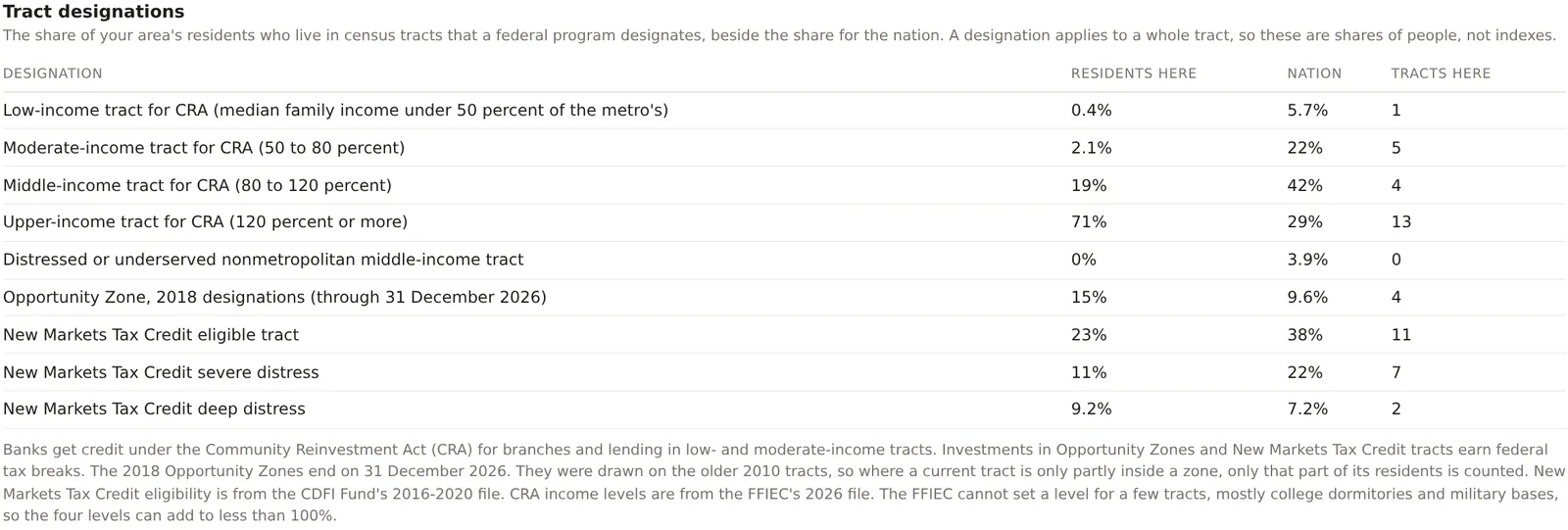
Each row gives the share of the area's residents living in tracts with the designation, the nation's share, and the number of such tracts the area touches. Residents are counted by the tract they live in from the 2020 census. A share well above the nation's means the area is one the program targets, and the tract count says over how many tracts.
The four CRA levels together describe where the area's residents sit against their metro's income, and the distressed line applies only outside metros.
An example
The Downtown Dallas project on 30 October 2026 read, for the CRA levels, 0.4 percent of residents in a low-income tract against 5.7 nationally, 2.1 percent in moderate-income tracts against 22, 19 percent in middle-income tracts against 42, and 71 percent in upper-income tracts against 29, over one, five, four and thirteen tracts. It read 15 percent of residents in a 2018 Opportunity Zone against 9.6 nationally, over four tracts, and 23 percent in New Markets Tax Credit eligible tracts against 38, with 11 percent in severe distress and 9.2 percent in deep distress tracts. The reading is a downtown that is upper-income by the CRA's measure for seven residents in ten, yet holds four Opportunity Zone tracts and several tracts that qualified for the New Markets credit on the older survey, which is common in a downtown that has been rebuilt since the designations were drawn.
Things to know
Designations are fixed to tracts and to the survey years each program used, so a tract that has changed since can carry a designation its residents no longer match, as the example shows.
The Opportunity Zone line will change on 1 January 2027 when the new zones take effect.
The CDFI Fund's files and the relationship file write Connecticut under its former counties, and the product matches those tracts to the current planning regions by their unchanged tract codes.
Related pages
Mortgage credit access comes before this card and Banking after. Named boundaries lets a tract be analyzed as itself. The methodology page gives each program's rules and files.