Job mix diversity
How evenly the jobs located in an area spread across twenty industry sectors, so how far the local economy leans on a few, against the nation at 100, with the Hachman index and the largest sector beside it for context.
What this is for
An area whose jobs are spread across many industries rides out a bad year in any one of them. An area that leans on one, a mill town, an oil county, a university district, does not. Job mix diversity measures that spread for the jobs located in an area, so that a business can judge how exposed the local economy is to a single industry's fortunes, and a lender can judge the same for a borrower's market.
The measure is of jobs where people work, not of residents' occupations, which the Work & Movement tab shows.
Where to find it
On the Economy tab, the seventh row of the summary table and the card headed Job mix diversity. Part of the Pro and Team plans.
How it is built
The jobs come from the Census Bureau's LODES data, the same workplace counts behind the jobs figures elsewhere, by twenty industry sectors. The measure is Shannon evenness, which is the entropy of the area's sector shares over the entropy of twenty equal shares. It reads 1 when every sector holds the same share of the jobs and 0 when one sector holds every job. The index is the area's evenness against the nation's, and the nation read 0.904 in 2023, so an area spread perfectly evenly reads about 111 and most areas read between 70 and 100.
Two figures sit beside it on the card for context and do not enter the index. The Hachman index is one over the sum of each sector's share times its location quotient against the nation. It reads 1 for a mix identical to the nation's and falls toward 0 as the mix departs from it, which is a different question from evenness. The largest sector is named with its share of the area's jobs and the nation's share of the same sector.
LODES publishes no margin, so the index has no range.
Reading the results
Above 100 is a more even mix than the nation's and below 100 a less even one. The two context figures explain why. An area can be spread nearly as evenly as the nation and still look nothing like it. Midland County, Texas reads 94 on evenness while its Hachman index is 0.05, because oil and gas holds 28 percent of its jobs against 0.4 percent nationally. The largest sector line says in words what the area leans on.
An example
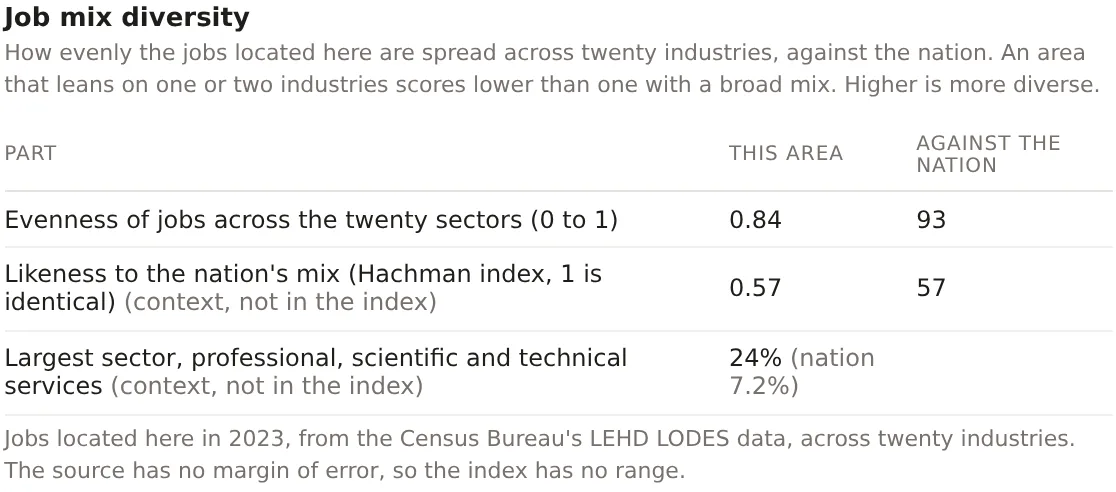
The Downtown Dallas project on 30 October 2026 read an evenness of 0.84 and an index of 93, against 100 for both the metro and the county. Its Hachman index was 0.57 and its largest sector was professional, scientific and technical services at 24 percent of jobs, against 7.2 percent nationally. The reading is a downtown whose 220,000 jobs lean on office industries, law, consulting, finance and the like, more than the nation's job mix does, with the next sectors well behind. A business selling to office workers reads that as its market, and a lender reads it as a concentration to note.
Things to know
The index is withheld below 1,000 jobs, where one employer moves the mix, so a residential neighborhood or a small town reads nothing rather than a figure made of a few workplaces.
LODES lags by about two years and the card names the year. An area touching Alaska or Michigan, whose last published years are older, says so.
The sectors are the Bureau's twenty, which group retail together, manufacturing together, and so on, so two areas with the same evenness can hold very different businesses within a sector.
Related pages
Social vulnerability comes before this card and Growth momentum after. The Work & Movement tab shows the jobs by industry the index is built from. The methodology page gives the formulas and the Midland County example.