Help › Competition and finding new sites
Co-tenancy profiles
How well the businesses around a location match the neighbors a brand usually has within a short walk of its stores, as a brand's match at each location, or as a ranking of the brands whose usual neighbors are already around a vacancy.
What this is for
Chains choose their neighbors. A brand's existing stores sit, more often than chance would put them, beside particular other brands and kinds of business, a coffee chain beside a gym and a grocery store, a steakhouse beside hotels and cocktail bars. A co-tenancy profile is that pattern, measured across every store of a brand, and the match says how much of the pattern is already present around a location. For a brand looking at a site, it is a check that the site keeps the company the brand's stores usually keep. For a landlord with a vacancy, the same arithmetic run the other way ranks the brands whose usual neighbors are already there.
It is about neighbors, not visitors. Nothing here observes who shops where, and a match says only that the businesses a brand usually sits beside are present.
Where to find it
The Co-tenancy card on the Businesses tab of the analysis page, with two modes, As a brand and As a vacancy. A co-tenancy line under a saved area's figures on the map uses the same profiles. Part of the Pro and Team plans.
How a profile is built
For every brand with at least twenty listed stores nationally, the profile is the set of brands and kinds of business found within 400 meters, a five minute walk in a straight line, of its existing stores, leaving out the brand's own other stores. Each neighbor carries the share of the brand's stores that have it, the base rate of that neighbor around branded stores in general, the lift as the ratio of the two, and a weight equal to the share times the logarithm of the lift, so that a neighbor that is both common and distinctive counts most. A neighbor enters the profile at a share of at least ten percent and a lift above 1.2, at most sixty per brand. Profiles are rebuilt after each monthly places capture, and each brand carries how much of its top twenty neighbors survived from the previous build, which the card shows as the profile's stability.
As a brand
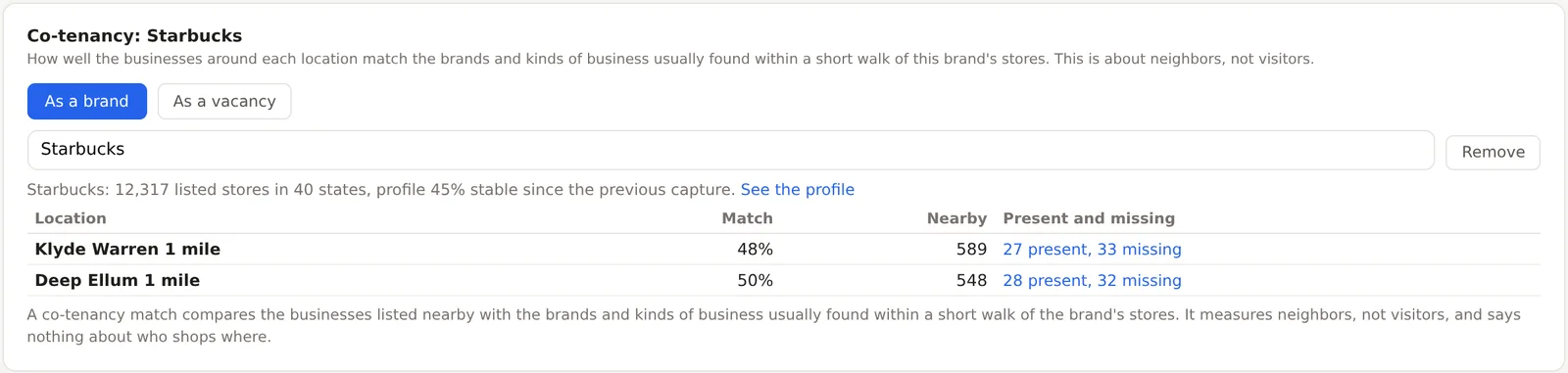
- With As a brand chosen, type a brand in the box, which offers brands with their store counts and kinds, and choose one.
- The card reads the brand's profile and looks up the neighbors around each of the project's locations.
- For each location it gives the match, the weight of the profile's neighbors listed within 400 meters of the location divided by the whole profile's weight, the number of businesses nearby, and how many of the profile's neighbors are present and missing, with each named so that the figure can be checked. See the profile opens the brand's full profile.
As a vacancy
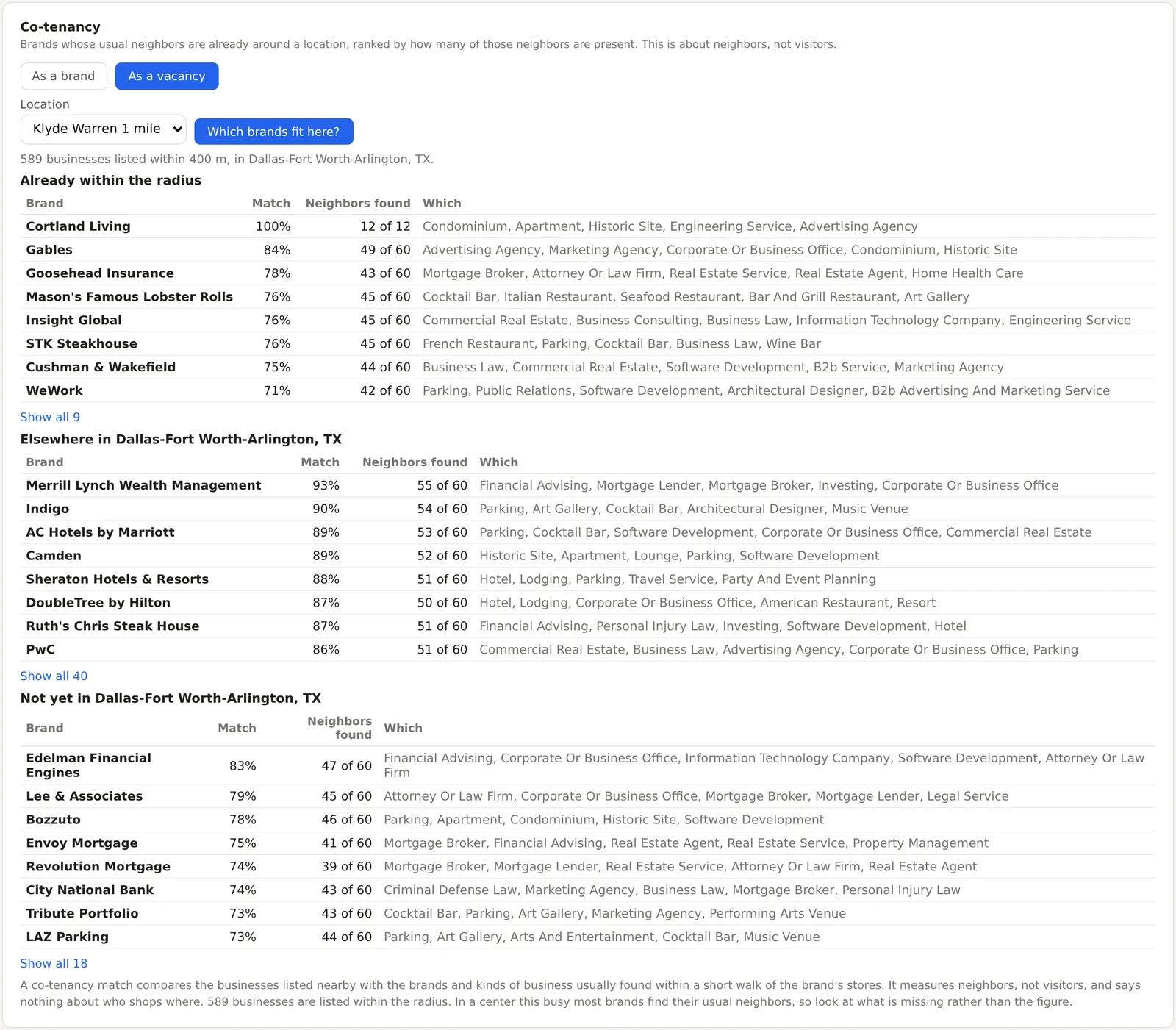
- With As a vacancy chosen, pick the location and press Which brands fit here?.
- The card scores every profiled brand against the businesses within 400 meters of the location and ranks them in three groups, already within the radius, elsewhere in the metro, and not yet in the metro, each with its match, its neighbors found of the profile's total, and the neighbors that drive the match.
The three groups answer three different questions. A brand already within the radius is a neighbor, not a prospect. A brand elsewhere in the metro is one that could open here and whose usual company is present. A brand not yet in the metro is a prospect for the market as a whole, and the location is where its profile fits.
An example
The Downtown Dallas project on 30 October 2026, as a brand, read a 48 percent match for Starbucks at the Klyde Warren location, with 589 businesses nearby and 27 of the profile's 60 neighbors present and 33 missing, and 50 percent at the Deep Ellum location, with 548 nearby and 28 present. Starbucks' profile was 45 percent stable since the previous capture, which is a brand whose neighbors vary by format. As a vacancy at the Klyde Warren location, among 589 businesses within 400 meters, the brands elsewhere in the metro whose profiles fit best were a wealth management firm at 93 percent with 55 of 60 neighbors found, a parking operator at 90, a hotel chain at 89 and an apartment operator at 89, and the brands not yet in the metro were led by a financial advisory firm at 83 percent. The ranking reads as a downtown office district, which is what the neighbors say it is.
Things to know
The profiles cover brands with twenty or more listed stores, keyed by name with punctuation and spacing removed, so a brand listed under two spellings has two profiles.
The 400 meter radius is a straight line and the same for every brand, because that is the distance the profiles were measured at.
A match is a share of a profile's weight, so a brand with a narrow, distinctive profile reads high or low sharply, and a brand with a broad profile reads in the middle almost everywhere.
The profiles cover the listed businesses alone, and a neighbor the sources have not captured counts as missing.
Related pages
Competition and market share counts the competitors rather than the company. The Businesses tab lists every business the profiles read. The methodology page gives the profile's arithmetic.