Fitness and wellness studios
Understand the area around your next studio
Evaluate who can reach a location, how the nearby population fits your membership profile and which fitness businesses are already there. Compare areas using travel times or consistent distances.
The decision
Compare potential members and nearby studios
Review population, income and age alongside the number of listed fitness businesses. Comparing businesses per resident helps you assess areas of different sizes. The Dallas examples show how markets with similar populations can have different levels of competition.
Measured
Similar populations with different fitness markets
| Three miles around | Residents | Median age | Median income | Daytime | Fitness places | Per 10,000 residents |
|---|---|---|---|---|---|---|
| Uptown Dallas | 176,832 | 32.9 | $94,195 | 507,639 | 273 | 15.4 |
| Legacy West, Plano | 99,809 | 37.7 | $114,805 | 239,976 | 102 | 10.2 |
| Firewheel, Garland | 99,529 | 38.7 | $96,793 | 70,559 | 28 | 2.8 |
Swipe the table sideways to see every column.
Fitness places include gyms, yoga and pilates studios, martial arts clubs and personal trainers. Sources and data periods are described on the methodology page.
Legacy West and Firewheel have almost the same number of residents, but 102 and 28 listed fitness businesses respectively. Legacy West also has a larger daytime estimate. Uptown Dallas has 15.4 fitness businesses per 10,000 residents, compared with 10.2 at Legacy West and 2.8 at Firewheel.
Screening on the real profile
Compare the demographic groups relevant to your studio
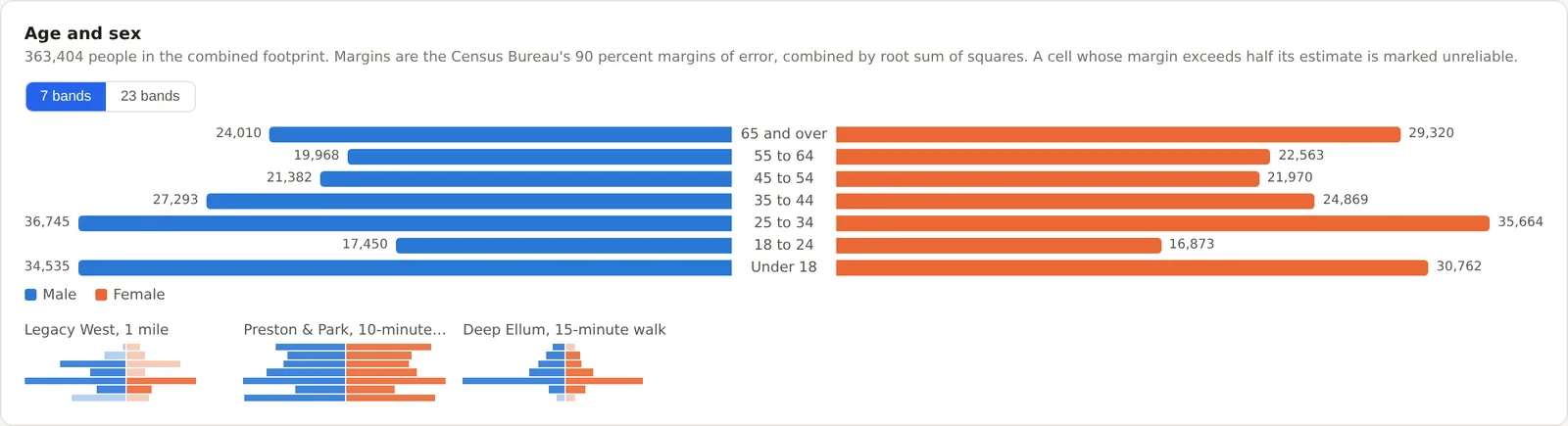
Combined Census tables let you explore age and sex together, such as women aged 25 to 44 within a travel area. You can also review households with children and other characteristics that help describe your membership market.
How to count the competition properlyQuestions
Questions people ask
What catchment does a boutique studio draw from?
Start with a journey time that fits your members' routines and compare it with what you know about existing studios. A ten-minute drive or a walking area can provide a useful starting point. Apply the same approach across candidate sites.
Can I see how many competing studios are already there?
Yes, by type. Gyms, yoga studios, pilates studios, martial arts clubs and personal trainers are separate categories, so you can count the format you compete with rather than every fitness business in the area.
Can I screen on ages and sexes rather than a median age?
Yes. MarketGround estimates age and sex groups from combined Census tables for your selected area. This lets you compare the groups relevant to your membership profile.
Does the daytime population matter for a studio?
It can help you evaluate the area around a studio that offers lunchtime or after-work classes. Review the daytime estimate alongside residents and jobs by industry, then compare the profile with your existing locations.
What about work from home?
Commuting measures include work from home. Reviewing these alongside the daytime population and local employment mix can help you understand the area around a studio.
Case study
A related example
Other trades
Explore other industries
Explore other industry examples or visit the research section for studies and practical guides.
Add local population, employment and travel access information to commercial property analysis.
Compare candidate stores with existing locations using consistent demographic and business measures.
Evaluate proposed territories and examine their overlap with existing franchise locations.
Use an existing studio as a reference
Analyze the area around a studio you know well. Compare its demographics and nearby fitness businesses with the locations you are considering next.